

The 21st century suffers less from a lack of solutions than from a lack of inner presence.
- Monastere Godoncourt

- Jan 4
- 3 min read
Interview selected for the 2026 edition ‘Visionaries of the 21st Century’ of the European journal www.interviewfrancophone.net.
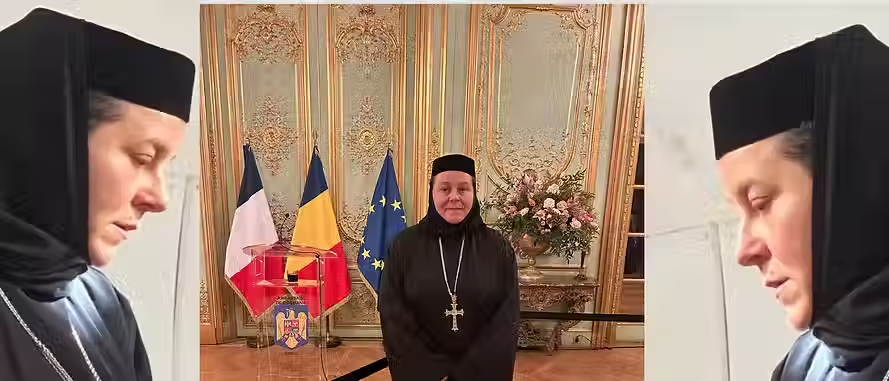
Interview Francophone: Quel est votre diagnostic sur les opportunités d'évolution des concepts de spiritualité et bienveillance pour contribuer à un meilleur 21e siècle?
Moniale Dorothee: The 21st century suffers less from a lack of solutions than from a lack of inner presence. Scattered, rushed, and saturated with stimuli, human beings struggle to remain attentive to themselves, to others, and to the world.
In the monastic tradition, spirituality is not an escape from reality, but a training in everyday attentiveness. Silence, slowness, and the repetition of gestures cultivate a quality of presence that makes action more just and relationships more stable.
Benevolence, for its part, is not a moral posture but an inner discipline. It arises from the recognition of one’s own fragility and is expressed through measured speech, patient listening, and a refusal of the subtle violence of judgment.
In a world that is accelerating, spirituality and benevolence can offer an essential contribution: forming women and men capable of remaining, discerning, and connecting. This may well be one of the silent revolutions our century needs.
Interview Francophone: What is the role of diaspora elites in innovation in the field of spirituality as a contribution to a better 21st century?
Moniale Dorothee: Diaspora elites, living between multiple cultures and systems of values, occupy a unique position to innovate in spirituality and in the way it is lived on a daily basis. They carry within them both the memory of ancient traditions and an understanding of the demands of the modern, scientific, and professional world. This dual perspective enables them to build bridges between heritage, ethics, and concrete practices of benevolence.
In the case of the Romanian diaspora, elites can highlight the riches of Orthodox spirituality—patience, silence, attentiveness to living beings, humility, and care—and translate them into language accessible to secular and pluralistic societies. When adapted to professional contexts, these values become resources for developing ethical, attentive, and sustainable practices, capable of transforming the way we interact with others and with the world.
For professionals like myself—veterinarians and researchers—this approach is particularly relevant. It allows us to connect scientific rigor with human sensitivity, to think of technology and medicine as tools in the service of life, and to integrate compassion and attentiveness into work environments often focused on performance.
Thus, diasporic elites do more than transmit a cultural or religious heritage: they open spaces of awareness, responsibility, and inner transformation, capable of nurturing a 21st century that is more balanced, ethical, and deeply human.
Interview Francophone: What is your personal journey and your choice of spirituality and action for the Godoncourt Monastery, a source of peace and sharing?
Moniale Dorothee: The Godoncourt Monastery, acquired in 2015 by Bishop Joseph, was created to become a place of spiritual growth and fraternal encounter, open to all Orthodox Christians as well as to anyone seeking meaning and spirituality, whatever their beliefs. Faithful to the Romanian monastic tradition, the monastery remains permanently open to visitors, offering a warm welcome and a space for reflection for everyone.
Life at Godoncourt is based on presence, simplicity, and attentiveness to others. Every gesture, every moment of prayer or work, is an opportunity to cultivate patience, benevolence, and inner harmony. Monastic spirituality is not limited to silence; it is expressed through action, care for others, and the sharing of human and spiritual experiences.
To encourage dialogue and exchange, the monastery also organizes concerts, exhibitions, conferences, and cultural meetings, allowing visitors to experience spirituality through art, reflection, and creativity. These initiatives strengthen Godoncourt’s role as a space of peace, culture, and social connection, where inner depth inspires openness, fraternity, and attentiveness to life.
In creating this place, Bishop Joseph sought to offer a space where spirituality is lived and shared, contributing to a world that is more humane, attentive, and fraternal.
© Interview Francophone — See the original article here.
Comments